
Toy University · Researcher perspective
The perfect playground has been designed many times, and never built
Beata Fuller
Researcher · Australia
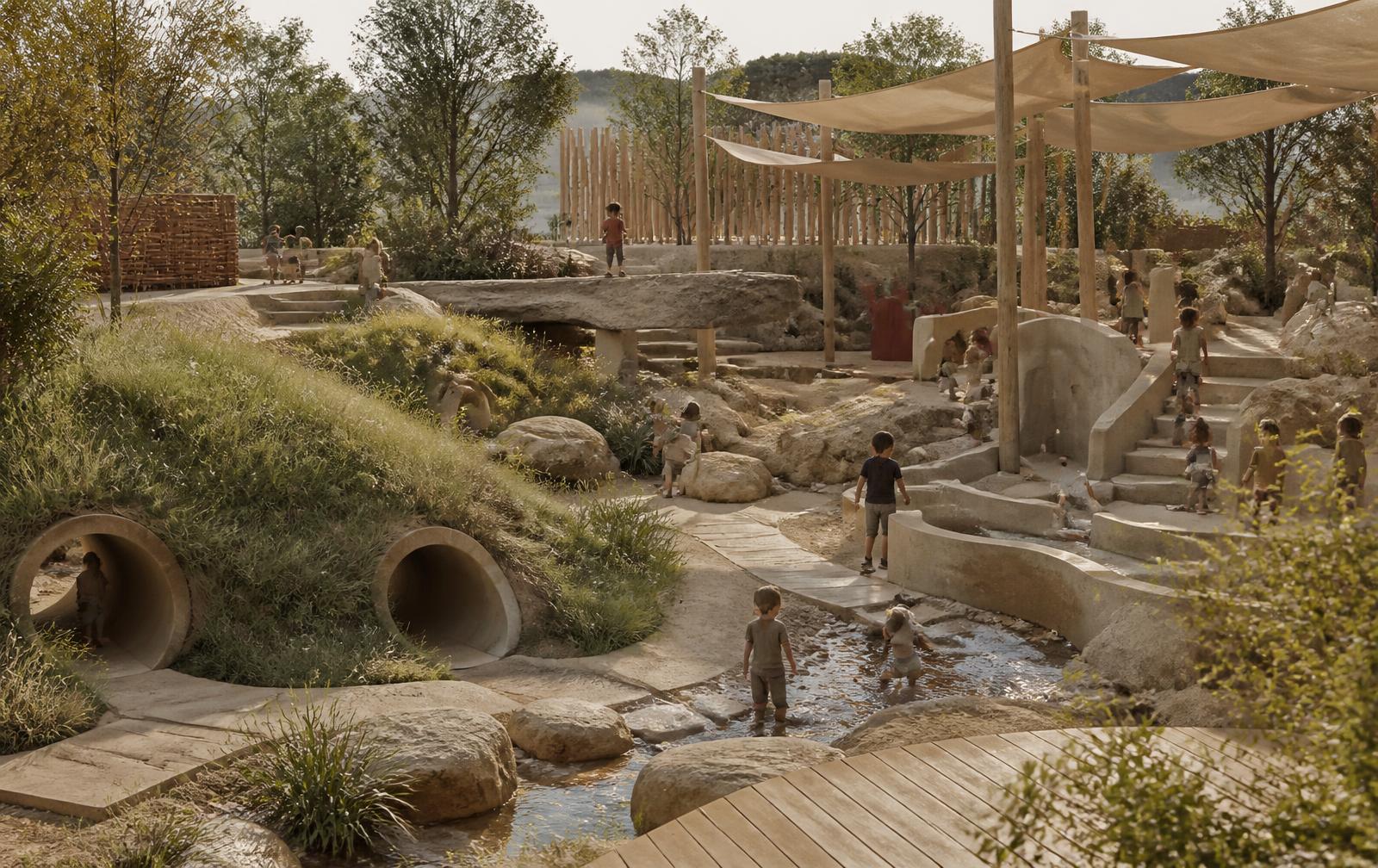
Put a child on a grassy hill and they'll want to roll down it. Nobody teaches them that; it’s an internal drive. Rolling connects parts of the brain in a way nothing else can. So what happens to the many children raised in places where they never get the hill?
The perfect playground has been designed many times, by our children’s bodies and minds. No adult has ever seen the design, most haven't asked for it, and nobody has considered building it. Until now.
Children already know what they need
Humans of all ages are naturally drawn to activities that promote their growth and development.
For three years I was the activities organiser for a group of about 50 families in our region. Every Monday we did something together: trampolining, kayaking, beach volleyball, surfing, board games, libraries, bushwalks and parks - we did it all. As an observer of humans, I noticed a pattern in how children engaged with their environment at different stages of development.
The same children were drawn to the same type of movements and activities, regardless of where we were, as though compelled by an invisible force.
Each age seeks something different: rolling down hills, jumping into puddles, rock-hopping, balancing on beams, stepping on cracks or avoiding them, building forts, crawling through tight spaces, waving sticks, whacking things, stacking things, building and knocking them down, and so on.
Until, as they reached their teens, the activities became less of a focus than hanging out together. No matter where we went, the teens did the activity for a little while, then found a place to sit and talk or made up their own group games. Once I found them sitting in the foam pit at a trampoline park, the next week scattered through branches of a large fig tree, and the week after that they tied their kayaks together in the middle of a river, so they could sit out of everyone else’s earshot and chat.
Had I been a school teacher, I might have told them to get on with the activity they came for. Thankfully I wasn't, and neither were any of the parents. We watched, and we changed the activities to fit what they were now seeking. We knew enough to realise that forcing them into something else would have created conflict for nothing, and got in the way of their development.
Children all over the world do these things because they are compelled to. Often the child who looks like they're "misbehaving" is feeding what their development needs in any way available to them.
That invisible compelling force is a blueprint every human is born with; a mind-map for the most efficient way to develop the skills they will need throughout life, skills that underpin everything they do and learn, no matter where or how they live.
The blueprint, and those skills, are universal.
What that play is building
Underneath the younger children's play sit the first two seeds of the 7 Seeds of Success®, the foundational skills everything else grows from. The first, Sensations, answers "where am I, and how big am I?"
The second, Senses, uses that answer to judge everything outside the body: how far away is it, how big is it, how close can I get before I touch it? Until someone knows how big they are, they can't tell how big anything else is.
A young brain organises itself through movement. Children are drawn to building cubbies, sitting inside boxes and going under tables, because every one of those tells the body its own size. And it's why sticks are one of the best toys there is: a stick is an extension of the body, and while you're still holding one end you can judge the distance to everything around you.
And if you don't think this is important in a world where most adults don’t need to know how far away their laptop sits, consider this: at the most basic level, Seed #1 evolves into ”how do I feel?" and “how do I navigate and change my internal sensations?”. Seed #2 is the precursor of sensing how far to stand from a person during a conversation.
Designed from the adult side
Most play spaces are designed from the other direction: what looks good, what feels safe to the adults, what is already in the catalogue. I once spoke at an education spaces design conference in the US, with a talk called "What if there is no box?" I listened to the other speakers present their ideas on innovative learning environments. Each one was still a school. Bigger windows, more green, different looking chairs, but there was no true innovation anywhere. I spent the entire time wondering: “Are we designing for the children, or patting ourselves on the back for a cool-looking space?”
The best playground is designed by children - not from what they say, but by what they do.
Many adults quote safety concerns when designing play and learning spaces. There is one problem with that: when children don't learn risks and consequences in the early years, the impact follows them through to adulthood. Keeping children safe is putting the adults they grow into at greater risk.
Sure, pool noodles can replace sticks for sword-fighting and whacking in many instances. They’re almost as good, but not quite. The child no longer has to judge the force they use, and if that judging is what’s needed, then they miss out.
A good playground provides opportunities without directing the play. Any equipment that can only be used for one thing is, in my opinion, a waste of space, and it often leads adults to make rules about how it can and can't be used. It's why, as every parent has seen, the box is so often a bigger hit than the thing inside it: it can be used in a thousand ways. Equipment that lends itself to one use only is essentially use-less, and that's exactly what children do: use it less.
The work nobody credits to the playground
When a child who has struggled suddenly "gets" reading, the classroom takes the credit. Often it was the playground that filled in what was missing: the hop-scotch game where they learned to look ahead of their feet (so they can see three words ahead of where they’re reading, like good readers do), the handball game where they learned to follow the ball with their eyes (so they can easily track along a line of text), the swing where they learned about rhythm and timing.
The impact of good playgrounds expands to every subject. I once gave a school leader a demonstration on a see-saw in their own playground. On a see-saw, children find out that a small person far from the middle can balance a bigger person close to it. This concept, usually taught in high-school, is discovered by children as young as five, years before anyone writes it on a board.
When life doesn't supply it, the environment can
Some children never have the hill or the tree in their backyard. I once worked with a family whose child never crawled, because they lived in a tiny space and there was nowhere to crawl. Not neglect, just the way their life was. A well-designed space can give a child what their daily life doesn't, which is why an excellent playground in every neighbourhood is so important.
And it doesn't require special materials; the principle is what matters. Providing opportunities the young bodies and minds are seeking. Anything that meets those criteria will do the job.
What is the criteria? Watch some kids in the wild, without adults directing them, and they’ll show you exactly what they need.
We don't need a particular material designed perfectly. In a way, that creates an artificial environment, and are the skills built there transferable to everyday life? I don't know.
Design it from nothing, starting with the children
A more modern version of an existing playground is still the existing playground. If playgrounds didn't exist, what would you build? Start by observing the natural behaviours of the children you're designing for, then build for them:
- Sticks, rocks, pebbles and loose objects of all kinds;
- water - for jumping in, pouring, splashing, spurting and squirting, and flowing - the more ways of interacting with it the better;
- things that can be whacked and banged, things that make noise;
- things to stack, build out of and knock over;
- things to climb in a hundred different ways;
- slopes to roll down or walk up (how ridiculous to tell kids they can’t walk up a slide when they ALL want to do it, don't they?);
- steps they can create and climb;
- space for somersaults and cartwheels;
- structures to swing on and hang off upside-down;
- balls and wheels to roll and throw and aim;
- sand and soil to turn into mud and run through their fingers, write in and build from;
- flowers and leaves and ants and bugs to inspect;
- different textures for feet and hands to experience;
- tunnels to crawl through, spaces to hide in;
- mysteries and treasures to discover, and to create for others to find;
And yes, spaces to sit and talk, out of earshot of the adults and out of reach of the younger kids. Because those conversations are building the future.
I have a whole section in my phone gallery with videos of playgrounds that got some of this right. I am yet to find the one I'd want in my grandchildren’s town.
Before you call them down
I often watch families out and about. And so often I see a parent stop a child from doing the exact thing that child needs. I’ve seen parents stop the play to go home and do the homework. I want to run after them and tell them, that what the children were doing was contributing more to the homework than doing the worksheet again and again.
So next time you stop the play to do some “more serious work”, before you call them down off the hill, before you tell them to play nicely and quietly, stop for a moment and watch what they're doing.
A great teacher doesn't teach, but expands on the learning already taking place.
PS Does this mean swings and slides and old-time playground favourites are out? Not necessarily, but they must not be limited to the use adults intended.
For example, the humble see-saw must be designed so it CAN be used in all the ways kids tend to use them: balancing at the pivot point and moving the swing with their feet by shifting their weight, walking along it from one end to the other like a pivoting balance beam, seeing how far they can propel the person at the other end into the air, jumping off the top while another person holds the other end down, etc etc. Same goes for simple swings - if they have rope attachments, children will always use them in many ways, the simplest being spinning them instead of swinging back and forth and seeing how far they’ll spin to the other side, standing on them instead of sitting, and so on, and so on. Whatever pieces are in the playground, their use must be left to the users’ imaginations, otherwise they fail at their job.
By Beata Fuller · Researcher · Australia
This article presents the author’s perspective.
Return to Playground